Insights
Strategic perspectives on operations, AI automation, and scalable business growth.
The Leaky Bucket: How Hidden Infrastructure Gaps Quietly Drain B2B Revenue
In the early stages of enterprise development, the founder is invariably the primary driver of growth. Every critical sales pipeline, strategic delivery, client relation, and daily operational pivot depends entirely on your immediate physical and cognitive presence. This hyper-centralized model is efficient, even necessary, when managing a portfolio of five clients.
BUSINESS STRATEGY & OPERATIONS


Why Modern Business Scalability Demands Ecosystem Oversight, Not Just Execution
BUSINESS STRATEGY & OPERATIONS
In the digital-first economy, agility is often touted as the ultimate competitive advantage. For growing enterprises and lean organizations alike, scaling operations swiftly means turning to external talent pools. The traditional reflex has been straightforward: identify a missing technical or creative capability, browse a talent marketplace, and contract a specialist directly.
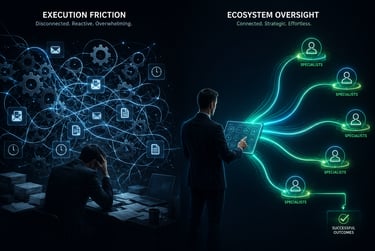

Are You the Engine or the Bottleneck of Your Business?
BUSINESS STRATEGY & OPERATIONS


In the business-to-business (B2B) landscape, growth bottlenecks are rarely dramatic. They don't appear as sudden system crashes or immediate sales drops. Instead, inefficiency manifests as a "leaky bucket"—a continuous, quiet drain of resources, leads, and operational hours through hidden gaps in your pipeline.
In the pursuit of enterprise scaling, B2B leadership often confuses velocity with acceleration. When growth plateaus, the default executive response is to demand more volume: increase the outbound lead volume, publish more content, or deploy more software tools. However, forcing a fragmented infrastructure to run faster does not produce linear growth; it merely accelerates system failure.

The Friction Tax: Why Velocity Alone Cannot Scale Modern B2B Operations
BUSINESS STRATEGY & OPERATIONS


The Predictability Mandate: Why Fragmented Operations Create Revenue Volatility
BUSINESS STRATEGY & OPERATIONS
In the high-ticket B2B sector, the most dangerous metric is not a lack of growth; it is a lack of predictability. When leadership cannot accurately forecast how their market visibility will translate into technical execution and finalized revenue, the enterprise is no longer scaling—it is gambling. Relying on isolated agencies and fragmented software tools introduces an unacceptable level of volatility into your pipeline.


The 4-Tier Integration Audit: Diagnostic Framework for B2B Operations
BUSINESS STRATEGY & OPERATIONS
Most B2B scaling bottlenecks do not stem from a failure in individual execution, but from structural fragmentation at the hand-off points. When an organization's visual communication, automated systems, custom technology, and pipeline acquisition operate on disparate data layers, the resulting friction drains profit and operational speed.
In the tech and SaaS sectors, high-velocity customer acquisition is often celebrated as the ultimate validator of enterprise health. Startups pump capital into lead generation, outbound funnels, and marketing campaigns to force a spike in valuation. However, scaling an enterprise without an integrated infrastructure is equivalent to bolting a commercial jet engine onto a wooden glider. The structural integrity will inevitably fail under the strain of its own power.

BUSINESS STRATEGY & OPERATIONS
System Shock: Post-Mortem of a Scaling Collapse
When B2B enterprises audit their operational expenses, leadership typically looks at direct line items: software licensing fees, agency retainers, and payroll. This traditional accounting method fails to capture the most volatile drain on modern corporate capital—the Fragmentation Tax.
BUSINESS STRATEGY & OPERATIONS
The Unit Economics of Infrastructure: Quantifying the Fragmentation Tax

The Unit Economics of Infrastructure: Quantifying the Fragmentation Tax
BUSINESS STRATEGY & OPERATIONS

In high-ticket B2B sales, the journey of a prospective client is rarely a straight line. It is a highly sensitive ecosystem where every touchpoint either builds absolute trust or introduces microscopic friction. Most enterprises evaluate their performance by looking at macro metrics: total leads generated, conversion rates, and revenue closed. However, to truly understand why growth plateaus, we must apply first-principles thinking ....
Over the past decade, the default strategy for solving an operational bottleneck has been to acquire a new piece of software. Need better lead tracking? Buy a new CRM. Need faster communication? Subscribe to a new messaging platform. Need deeper analytics? Integrate a new dashboard. This reflex has led to the "SaaS Accumulation Trap.

BUSINESS STRATEGY & OPERATIONS
The End of the SaaS Patchwork: Why Elite Enterprises are Shifting to Unified Ecosystems
The Algorithmic Revenue Engine: Reverse-Engineering a Modern Growth Stack
BUSINESS STRATEGY & OPERATIONS

For years, B2B enterprise growth was a volume game. Organizations deployed isolated tactics: a standalone Google Ads campaign, a siloed outbound email sequence, and fragmented social media outreach. The operational philosophy was simple: push enough volume into the market, and conversions will eventually materialize.
How Programmatic SEO and AEO Build Autonomous B2B Lead Engines
BUSINESS STRATEGY & OPERATIONS


What is a Programmatic SEO Lead Engine?: A Programmatic SEO Lead Engine is an enterprise growth architecture that uses automated software workflows to deploy hundreds of hyper-targeted, high-intent landing pages structured around specific B2B buyer problems. Unlike traditional SEO which focuses on generic blog traffic, Programmatic SEO....
An Enterprise AI Stack is an integrated architectural layer that embeds autonomous workflow engines, retrieval-augmented knowledge agents, cognitive document parsing, and automated content generation directly into an organization’s data ecosystem. Unlike standalone AI tools that require constant human prompting, a fully engineered AI Stack bridges cross-platform databases...

BUSINESS STRATEGY & OPERATIONS
The Autonomous Enterprise: Replacing Operational Latency with Intelligent Infrastructure
The Unified Scaling Engine: Combining Growth Stacks and Enterprise AI for Global B2B Expansion
BUSINESS STRATEGY & OPERATIONS

A Unified Growth + AI Stack is an integrated enterprise architecture that fuses algorithmic buyer acquisition channels with autonomous AI infrastructure. While the Growth Stack handles real-time intent signal detection, multi-channel outreach, and programmatic visibility, the AI Stack automates lead enrichment, cognitive document extraction, and zero-latency CRM routing.
The Autonomous Enterprise: Replacing Operational Latency with Intelligent Infrastructure
BUSINESS STRATEGY & OPERATIONS

An Autonomous Freight Brokerage Engine is a unified digital architecture that combines programmatic shipper acquisition (Growth Stack) with cognitive supply chain automation (AI Stack). The system monitors real-time freight signals to capture high-intent shippers, while using AI document parsing and RAG knowledge agents to automate Bill of Lading (BOL) extraction....
An Autonomous Enterprise SaaS Pipeline is a unified digital architecture designed to drastically shorten complex B2B sales cycles. By combining Programmatic AEO (Growth Stack), interactive technical audit tools (Development Stack), and intelligent routing (AI Stack), organizations can capture hyper-specific CTO/CISO search intent and validate technical requirements instantly.


BUSINESS STRATEGY & OPERATIONS
Accelerating Enterprise SaaS Sales: From 6 Months to 6 Weeks via Autonomous Technical Agents
The Autonomous Fintech Pipeline: Accelerating B2B Payment Infrastructure Onboarding
BUSINESS STRATEGY & OPERATIONS


An Autonomous Fintech Pipeline is a consolidated infrastructure that fuses intent-driven enterprise acquisition (Growth Stack) with zero-latency compliance and document processing (AI Stack). Instead of forcing institutional clients through weeks of manual KYB/AML checks and API schema reviews, the system utilizes cognitive extraction and RAG agents to parse financial documentation and validate compliance instantly.
The Build vs. Deploy Paradox: Why In-House AI Engineering is an Enterprise Sunk Cost Trap
BUSINESS STRATEGY & OPERATIONS


The Build vs. Deploy Paradox is an operational fallacy where enterprise leaders spend millions of dollars and up to 12 months attempting to build custom AI infrastructure from scratch, only to produce fragmented, outdated, and unscalable systems. The optimal economic solution is deploying a pre-engineered, unified architecture.
An Autonomous Retention Engine is a post-sale infrastructure that merges the Growth and AI Stacks to maximize Customer Lifetime Value (LTV) and prevent churn. Instead of relying on manual Customer Success Managers (CSMs) to handle routine onboarding and support, the system utilizes cognitive document extraction for zero-latency client setups and RAG-powered agents for 24/7 technical troubleshooting.


BUSINESS STRATEGY & OPERATIONS
The Autonomous Retention Engine: Scaling Customer Success Without Scaling Headcount
The Legacy Infrastructure Trap: Why Fragmented Backend Architecture Kills Enterprise AI
Architecting the Enterprise Portal: Why Off-the-Shelf SaaS Fails Complex Business Logic
BUSINESS STRATEGY & OPERATIONS
BUSINESS STRATEGY & OPERATIONS


The Legacy Infrastructure Trap occurs when an enterprise attempts to scale front-end AI or programmatic growth engines on top of siloed, outdated backend systems. Disjointed ERPs, legacy CRMs, and unstandardized databases introduce severe data latency and synchronization failures, making advanced automation impossible.
An Enterprise Portal Architecture is a custom-engineered frontend interface built to execute highly specific business workflows that generic, off-the-shelf SaaS cannot support. By deploying the ModusStack Development Stack, organizations bypass the rigid limitations of commercial software, engineering centralized, zero-latency dashboards for internal teams and high-ticket clients.
It is the operational mistake of hiring disconnected agencies—one for creative design, another for marketing, a third for software development, and a fourth for AI consulting. This fragmented approach creates data silos and severe execution latency. The optimal economic solution is deploying a unified ecosystem where Creative, Growth, Development, and AI Stacks operate natively as a single engine, eliminating integration debt and reducing overhead costs.


BUSINESS STRATEGY & OPERATIONS
The "Vendor Patchwork" Fallacy: Why Fragmented Agencies Kill Enterprise Scaling
Anatomy of an Autonomous Deal: How 4 Unified Stacks Execute High-Ticket B2B Sales
BUSINESS STRATEGY & OPERATIONS

An Autonomous Deal is a high-ticket B2B transaction executed through a continuous, synchronized digital pipeline rather than disconnected manual hand-offs. By orchestrating Creative (Authority Branding), Growth (Programmatic AEO), Development (Custom Portals), and AI (Cognitive Validation & Provisioning) into a single operational architecture, enterprises capture institutional demand, validate complex technical requirements, and provision client environments.....
The Trust Architecture: Why High-Ticket B2B Closes on Engineering Precision and Brand Authority
ENTERPRISE STRATEGY & PRODUCT DESIGN
In high-ticket enterprise transactions, decision-makers do not evaluate your software through logical evaluation alone. Long before a CTO reviews your API schema or a CFO assesses your payback period, they have already formed a visceral conviction regarding your operational maturity. This evaluation is dictated by digital body language. When a multi-million-dollar buyer visits your digital touchpoints, every single pixel, frame rate drop....

In the enterprise B2B landscape, the most dangerous illusion is top-of-funnel volume. Marketing departments frequently celebrate surges in organic traffic, impressions, and form clicks. Yet, when CFOs and CROs review the pipeline, the revenue impact is virtually undetectable. Millions of impressions produce anemic pipeline velocity, prolonged procurement cycles, and rampant deal slippage.

ENTERPRISE STRATEGY & PRODUCT DESIGN
The Intent Capture Matrix: Why High-Volume Traffic Fails Without Structural Creative Authority
The Engineering-Led Growth Engine: Why Software-as-Acquisition Dominates B2B Enterprise Sales
ENTERPRISE GROWTH & SOFTWARE ARCHITECTURE

In the world of high-ticket B2B enterprise technology, traditional marketing is experiencing a catastrophic collapse in efficacy. Chief Technology Officers, Chief Information Officers, and Enterprise Architects do not read 40-page generic eBooks. They do not fill out forms to access gatekept slide decks, and they immediately purge unsolicited outbound sales emails from their inboxes.
The Cognitive Brand Architecture: Scaling Institutional Authority with AI-Driven Creative
ENTERPRISE BRAND STRATEGY & ARTIFICIAL INTELLIGENCE

In high-ticket enterprise sales, momentum is your most valuable asset. Yet, most organizations actively destroy it through operational creative bottlenecks. When a multi-million-dollar deal reaches the evaluation phase, enterprise buyers expect hyper-personalized intelligence. A Chief Information Security Officer (CISO) does not want a generic 40-page PDF brochure....
Enterprises are wasting hundreds of thousands of dollars every quarter funding an outbound sales model that no longer works. The traditional playbook has collapsed: purchase a static database of unverified contacts, hire an army of Sales Development Representatives (SDRs), and blast tens of thousands of generic email sequences across the market.


ENTERPRISE GROWTH & ARTIFICIAL INTELLIGENCE
The Autonomous Acquisition Engine: Replacing Cold Outbound with AI-Powered Intent Infrastructure
The Autonomous Resolution Engine: Transitioning from Deflection to Execution
ENTERPRISE RETENTION & ARTIFICIAL INTELLIGENCE


Enterprises are hemorrhaging high-ticket clients by deploying support infrastructure optimized for deflection rather than resolution. The standard industry approach relies on basic decision-tree chatbots. When an enterprise client encounters a critical system failure, they are forced through a rigid sequence of keyword-triggered prompts, only to be fed a link to a generic documentation page. This creates immense operational friction.
Over the past 12 months, B2B enterprises have aggressively allocated capital toward Generative AI. Leadership teams purchase premium LLM licenses and mandate AI integration across customer service, sales, and operations. However, the executive dashboard reveals a stark reality: the initiatives are failing. Employees are experiencing severe AI hallucinations, workflow latency has increased.....


The AI Illusion: Why Your Generative AI Initiatives Are Failing
DATA ARCHITECTURE & ARTIFICIAL INTELLIGENCE
As enterprise growth accelerates, leadership faces a critical operational ceiling. To scale revenue, departments are requesting proportional increases in headcount. However, hiring more analysts, sales development reps, and support staff is actively compressing your profit margins. Simultaneously, employee burnout is at an all-time high. Highly compensated professionals are spending the majority of their work hours doing manual data entry....


ENTERPRISE STRATEGY & ARTIFICIAL INTELLIGENCE
The Synthetic Workforce: Transitioning Your Team from Operators to Orchestrators
The Execution Chasm: Why Boardroom Vision Collapses in Digital Reality
ENTERPRISE ARCHITECTURE & BUSINESS STRATEGY


The board of directors approves an ambitious digital transformation and market expansion strategy. The executive mandate is clear: establish dominant market presence, capture high-value enterprise accounts, and modernize the operational footprint. Millions in capital are allocated. Twelve months later, the executive dashboard reveals a troubling disconnect. The digital surfaces released to market...
Your engineering team has built a demonstrably superior product. The underlying architecture is faster, more secure, and mathematically more capable than anything else on the market. Yet, in competitive enterprise procurement cycles, you are consistently losing deals to legacy competitors with outdated, inferior technology. When your sales team does manage to win a client, it requires severe discounting...


ENTERPRISE STRATEGY & PRICING POWER
The Authority Deficit: Why Superior Products Lose to Inferior Competitors
ModusStack
Delivering high-performance digital and AI
services
© 2026 ModusStack. All rights reserved. Operated by VBK THAI COMPANY LIMITED
solutions through methodical efficiency.
Company
Legal
Terms and conditions