Are You the Engine or the Bottleneck of Your Business?
BUSINESS STRATEGY & OPERATIONS
Modusstack Team
4 min read
Introduction: The Trap of the High-Hustle Operator
In the early stages of enterprise development, the founder is invariably the primary driver of growth. Every critical sales pipeline, strategic delivery, client relation, and daily operational pivot depends entirely on your immediate physical and cognitive presence. This hyper-centralized model is efficient, even necessary, when managing a portfolio of five clients. It allows for rapid iteration and personal oversight. However, when an organization attempts to transition from a boutique operation to an exponential scale, this exact same operational framework mutates into a destructive trap.
As order volumes increase and the ecosystem expands, leaders instinctively react by working longer hours and micro-managing more nodes. They confuse revenue growth with systemic scalability. In reality, if every single daily operational decision, client artifact approval, or tactical communication must pass through you to get validated, you are no longer the engine of your enterprise. You have become its primary bottleneck. You do not own a scalable business architecture; you own a highly volatile, high-stress job that limits your organization’s capacity to the boundaries of your personal burnout.
To scale predictably in a modern market, an organization must separate human dependency from repetitive execution. It requires shifting your executive role from a day-to-day tactical operator to a high-level operational architect.

2. Tactical Automation and SaaS Infrastructure Integration
Once your workflows are codified, the next strategic step is separating human judgment from repetitive execution. A massive percentage of daily business operations—such as data replication, status reporting, standard client follow-ups, and email routing—requires zero high-level cognitive energy. Forcing human labor to execute these tasks is an inefficient allocation of capital.
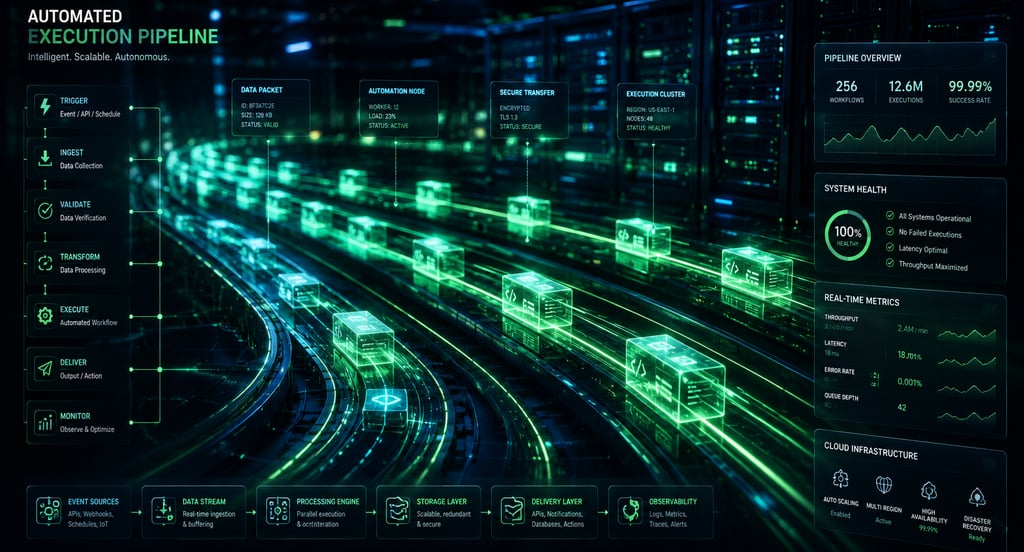
Under an optimized operational ecosystem, human dependency in these micro-domains is completely eliminated. We integrate advanced, automated SaaS infrastructure to act as the primary engine of execution. Software protocols and automated pipelines handle the movement of data, client assets, and operational triggers across your network on rails. By shifting the burden of repetitive execution to automated infrastructure, the operation achieves elite processing speeds, slashes overhead costs, and eliminates the risk of human error.
3. Isolated Governance and Exception-Based Management
Eliminating the bottleneck does not mean abandoning quality control. It means redefining how control is maintained. In a human-dependent business, the leader is forced to act as a constant quality filter, reviewing every minor detail before deployment.
An enterprise-grade architecture replaces this with an isolated governance model known as Exception-Based Management. Your automated infrastructure is designed to handle 95% of standard daily operations automatically. Human intervention is strictly isolated and reserved for the remaining 5% of exceptions—high-value scenarios that genuinely demand strategic human judgment, creative problem-solving, or complex client interactions. What arrives at your executive dashboard is not an endless pile of operational fire-fighting tasks; it is a clean, automated dashboard that allows you to manage system compliance rather than manual labor.
Ultimately, the true test of your business infrastructure is your complete absence. If you turn off your phone, close your laptop, and step away from the office for 30 days, does your enterprise revenue keep growing on an exponential curve? Or does your entire operational framework collapse into chaos? If it breaks, your business is not scalable.
Relying on human-centric hustle turns executives into high-paid micro-managers, starving the company of the strategic focus required for market expansion and product innovation.
By building an autonomous, system-driven infrastructure with ModusStack, you stop working in your business and start working on your business. You transition from a manual operator to an enterprise architect, deploying a predictable, highly automated machine built for continuous, scalable growth—all governed through a single, seamless channel.
Ready to build a business that runs itself?


The Construction Analogy: The Architect vs. The Laborer
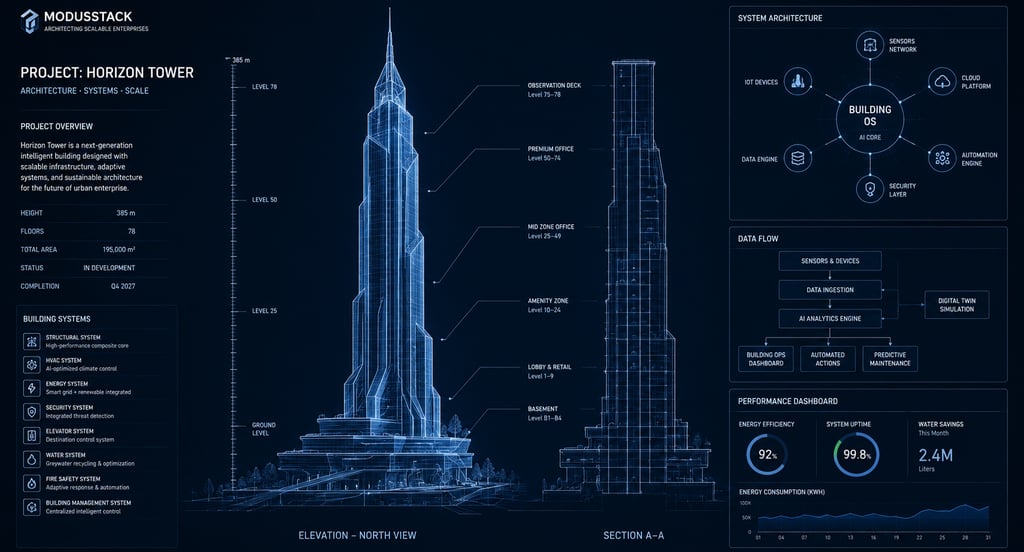
To understand how systemic autonomy functions, consider the architectural design of a high-rise commercial development. An architect does not spend their days standing on the construction site manually laying bricks, mixing cement, or fastening steel beams. If the architect insists on physically executing or approving every individual mechanical action, the construction grinds to a halt. The project becomes severely limited by one person's physical speed.
Instead, the architect designs an immutable blueprint—a comprehensive framework that specifies exactly how systems interface, how materials load, and how processes flow. Once the blueprint is approved, specialized, automated execution mechanisms take over. The architect steps back to observe the ecosystem from a macroscopic level, ensuring compliance with the original vision while the machine builds itself.
In professional services and e-commerce infrastructure, your business operations must be treated with the exact same architectural rigor. You pay for the design of the outcome, not the accumulation of your own manual hours.

The Three-Tiered Blueprint: Building a System-Driven Operation
To transition your organization from human dependency to architectural autonomy without sacrificing premium quality, you must implement a robust, three-tiered framework. This strategy systematically removes individual-dependent variables and replaces them with automated, software-driven repeatability.
1. Structural Process Auditing and Workflow Mapping
The first point of operational failure occurs when a business attempts to scale processes that are poorly defined or live entirely inside a manager's head. When operations rely on tribal knowledge, execution becomes inconsistent, and errors compound exponentially.
A scalable architecture begins with a ruthless workflow audit. Every recurring process that occurs more than three times a week must be extracted, mapped, and codified. We dissect the inputs, decision thresholds, and final outputs of your daily routines. By translating vague human tasks into precise, linear step-by-step algorithms, we eliminate ambiguity. This structural alignment guarantees that your operations are guided by documented corporate systems rather than unpredictable individual perspectives.
modusstack.com | Business Insights
Conclusion: Designing the Machine, Not Running It
ModusStack
Delivering high-performance digital and AI
services
© 2026 ModusStack. All rights reserved. Operated by VBK THAI COMPANY LIMITED
solutions through methodical efficiency.
Company
Legal
Terms and conditions