Lifecycle of a High-Ticket Lead: A Tale of Two Infrastructures
BUSINESS STRATEGY & OPERATIONS
Modusstack Team
3 min read
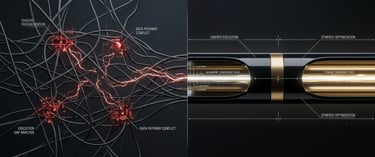
Introduction: The Invisible Gauntlet
In high-ticket B2B sales, the journey of a prospective client is rarely a straight line. It is a highly sensitive ecosystem where every touchpoint either builds absolute trust or introduces microscopic friction.
Most enterprises evaluate their performance by looking at macro metrics: total leads generated, conversion rates, and revenue closed. However, to truly understand why growth plateaus, we must apply first-principles thinking and examine the micro-journey of a single high-value prospect.
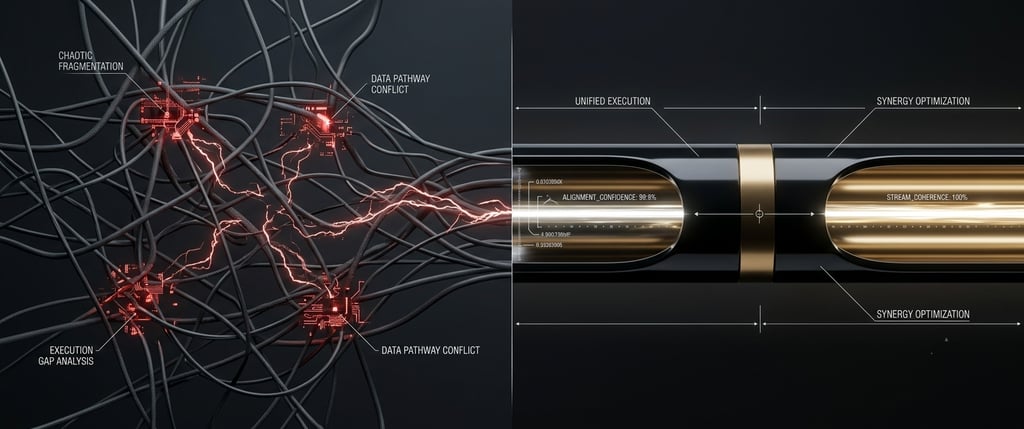
Let us track the lifecycle of a hypothetical $100,000 enterprise lead as it moves through two completely different operational environments: the Traditional Patchwork System and the ModusStack Unified Engine.
Phase 1: The Initial Hook (Acquisition)
The Traditional Patchwork:
The lead is acquired through a manual outbound campaign. An SDR (Sales Development Representative) sends a generic email template. Because the targeting data is not dynamically updated, the message is slightly misaligned with the prospect's current market challenges. The lead replies out of mild curiosity, but the SDR takes 14 hours to respond because the email system is not integrated with the central CRM. Friction is introduced on day one.
The ModusStack Unified Engine (Growth Stack):
The lead is identified through a mathematical outbound framework. Automated data scrapers detect a specific organizational shift within the prospect's company. An autonomous sequence reaches out with hyper-personalized relevance. When the lead replies, the system instantly logs the interaction and alerts the strategic team in real-time. The response is immediate, precise, and highly relevant.
Phase 2: The Comprehension Gap (Creative)
The Traditional Patchwork:
The lead agrees to a discovery call and requests more information. The enterprise sends a 25-page, text-heavy PDF brochure. The lead, a busy executive, opens the document on a mobile device between meetings, scrolls for 15 seconds, fails to understand the core mechanical advantage of the product, and closes it. They enter the discovery call completely cold, forcing the account executive to spend 30 minutes explaining basic concepts rather than discussing strategic implementation.
The ModusStack Unified Engine (Creative Stack):
Upon booking the call, the lead is automatically sent a secure link to a 90-second, high-fidelity whiteboard animation. The visual asset meticulously breaks down the complex software architecture into easily digestible concepts. The executive watches the entire video, immediately grasps the value proposition, and enters the discovery call ready to discuss technical integration and pricing. The sales velocity is instantly compressed.
Conclusion: Occam's Razor in B2B Operations
Occam's Razor dictates that the simplest solution, requiring the fewest assumptions, is usually the correct one. In the context of enterprise architecture, the simplest solution is not managing ten different software tools and hoping they align. The simplest solution is consolidating your operations into a single, unified engine.
Friction is not a natural byproduct of doing business; it is the penalty for fragmented infrastructure. When your Growth, Creative, AI, and Development stacks operate in total synchronization, you stop losing deals to operational lag and start commanding your market share.
Synchronize your enterprise journey.
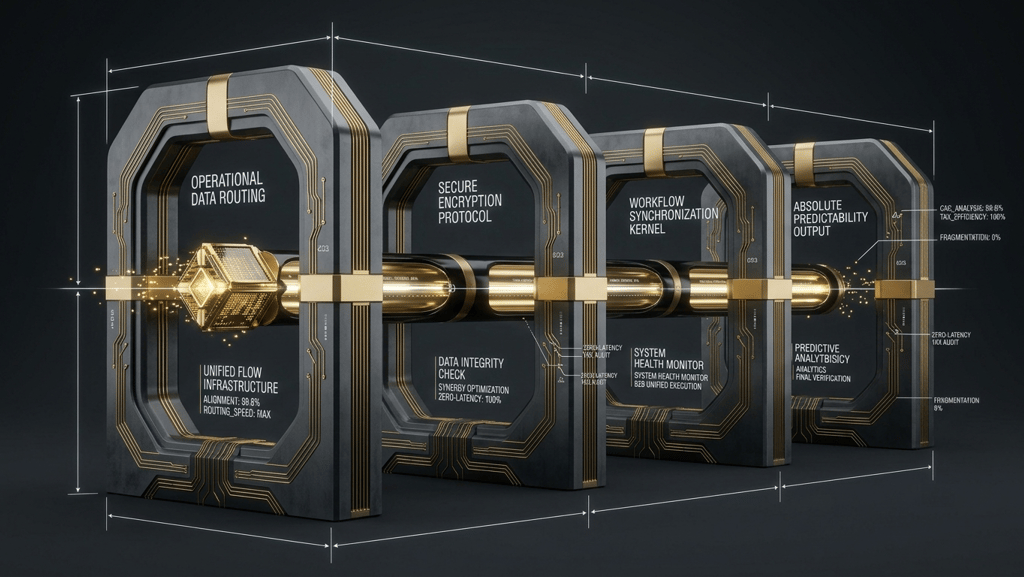
Phase 3: The Internal Hand-off (Data Routing)
The Traditional Patchwork:
The lead verbally commits to a pilot program. Now, the internal chaos begins. The account executive must manually extract the client's parameters from their notes, input them into the CRM, copy them into a project management tool, and draft an email to the technical team. A minor transcription error occurs—a single zero is missed in the volume requirements. This human error will remain undetected until the deployment phase, virtually guaranteeing a disastrous client onboarding experience.
The ModusStack Unified Engine (AI Stack):
The verbal commitment triggers an autonomous workflow. AI knowledge agents instantly parse the meeting transcript, extract the exact technical parameters, and populate the CRM, the billing software, and the development pipeline simultaneously with absolute zero latency and zero human transcription error. The technical team receives a flawless operational brief before the account executive even closes their laptop.
Phase 4: The Scale and Delivery (Infrastructure)
The Traditional Patchwork:
The pilot program launches, and the client integrates their database. Because the enterprise relies on fragmented, off-the-shelf software extensions, the sudden spike in data volume causes an API bottleneck. The system experiences a 45-minute outage. Trust, which took months to build, evaporates in minutes. The $100,000 deal is downgraded, and expansion opportunities are lost.
The ModusStack Unified Engine (Dev Stack):
The client scales their data input by 1,000%. The bespoke, enterprise-grade application layer dynamically allocates server resources to handle the load without a single millisecond of performance degradation. The infrastructure operates precisely as engineered. The client experiences flawless continuity, resulting in a seamless contract renewal and immediate expansion.
ModusStack
Delivering high-performance digital and AI
services
© 2026 ModusStack. All rights reserved. Operated by VBK THAI COMPANY LIMITED
solutions through methodical efficiency.
Company
Legal
Terms and conditions