The End of the SaaS Patchwork: Why Elite Enterprises are Shifting to Unified Ecosystems
BUSINESS STRATEGY & OPERATIONS
Modusstack Team
3 min read


IIntroduction: The SaaS Accumulation Trap
Over the past decade, the default strategy for solving an operational bottleneck has been to acquire a new piece of software. Need better lead tracking? Buy a new CRM. Need faster communication? Subscribe to a new messaging platform. Need deeper analytics? Integrate a new dashboard.
This reflex has led to the "SaaS Accumulation Trap." The average mid-market B2B enterprise currently operates using over 100 distinct software applications. Leadership operates under the assumption that more tools equate to higher capability.
However, from an architectural standpoint, acquiring fragmented software does not build capability; it builds complexity. We are reaching the terminal limits of the SaaS patchwork era. The next iteration of elite enterprise scaling requires a fundamental paradigm shift: moving away from isolated tools and toward a single, synchronized Unified Ecosystem.
Part 1: The API Illusion
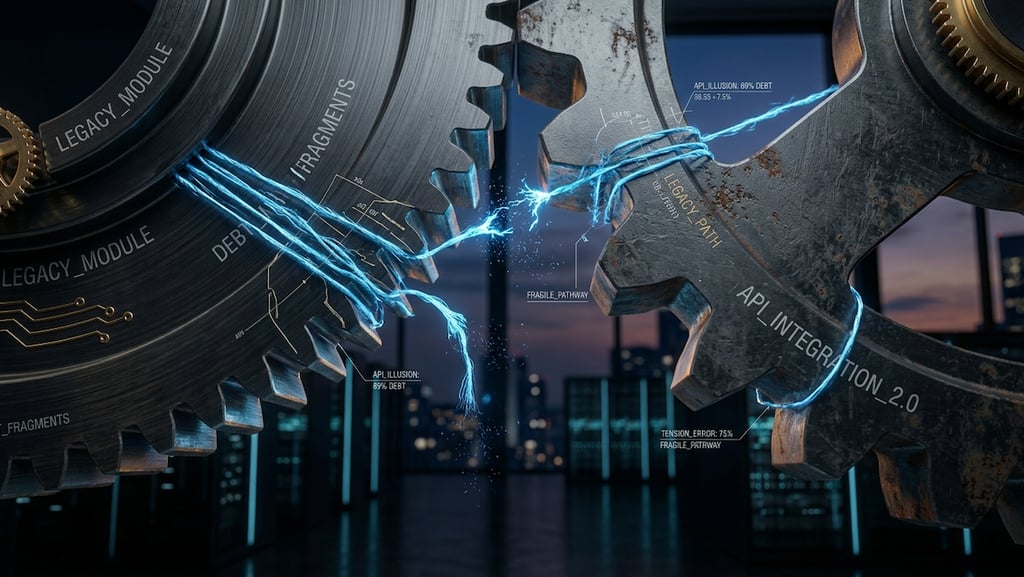
To mitigate the chaos of utilizing dozens of different platforms, organizations rely heavily on APIs (Application Programming Interfaces) and third-party automation tools to force these disparate systems to communicate. We call this "The API Illusion."
While an API can transfer a data packet from Platform A to Platform B, it does not unify the underlying logic of the operations.
Version Conflicts: When Platform A updates its code, the API connection to Platform B frequently breaks, causing silent data loss that may go unnoticed for weeks.
Security Vulnerabilities: Every connection point between unlinked software is a potential breach vector. The wider the patchwork, the larger the attack surface.
Latency Cascades: Data forced through multiple third-party bridges experiences micro-delays. At scale, these delays cascade, resulting in outdated reporting and reactive decision-making.
Bolting mismatched software together with digital duct tape does not create a system. It creates a highly fragile dependency chain.
Conclusion: Engineering the Monolith
The era of the SaaS patchwork is concluding. Elite B2B enterprises are realizing that competitive advantage is no longer found in having the most software, but in having the most synchronized architecture.
By replacing disconnected variables with a unified engine, leadership reclaims absolute control over their pipeline velocity, data integrity, and operational margins.
You cannot build an anti-fragile enterprise on a fragmented foundation. Stop subscribing to tools. Engineer an outcome.
Transition to a Unified Ecosystem.

Part 2: The Cognitive and Operational Debt
The financial cost of maintaining a fragmented software stack is easily quantified. The hidden, more destructive cost is the cognitive load it places on human capital and executive leadership.
Context Switching and Executive Drag
When an organization’s Growth, Creative, and Technical assets reside in separate silos, employees are forced into constant context switching. An account executive must log into a prospecting tool, extract the lead, switch to a CRM, locate the corresponding marketing asset in a cloud drive, and then brief the technical team via a completely different project management app.
This operational drag reduces high-level cognitive workers to manual data-entry clerks. It strips away their ability to focus on strategic deployment and client relationships.
The Analytics Void
In a fragmented architecture, achieving a single source of truth is mathematically impossible. The marketing software reports one conversion metric, the sales CRM reports a different closing velocity, and the fulfillment application shows conflicting retention data. Leadership is forced to make critical financial decisions based on fragmented, reconciled estimates rather than absolute real-time reality.
Part 3: The Occam's Razor of Enterprise Scaling
Occam’s Razor posits that entities should not be multiplied unnecessarily, and the simplest explanation or solution is usually the correct one. Applying this to operational architecture yields a clear directive: stop multiplying your software subscriptions.
The solution to operational friction is not to buy another app to manage your existing apps. The solution is to deploy a Unified Ecosystem.
This is the architectural philosophy behind the ModusStack engine. We do not offer disjointed tools; we construct a synchronized operational continuum.
The Growth and Creative Synergy: Acquisition algorithms function on the exact same data layer as the visual communication assets. When a market shift occurs, the outreach messaging and the high-fidelity sales assets pivot simultaneously.
The AI and Development Core: Autonomous workflow agents do not cross external API bridges; they operate within the native infrastructure. Data routes instantly from the initial client interaction directly to the custom development fulfillment layer with absolute zero latency and zero transcription error.
ModusStack
Delivering high-performance digital and AI
services
© 2026 ModusStack. All rights reserved. Operated by VBK THAI COMPANY LIMITED
solutions through methodical efficiency.
Company
Legal
Terms and conditions