Why Modern Business Scalability Demands Ecosystem Oversight, Not Just Execution
BUSINESS STRATEGY & OPERATIONS
Modusstack Team
4 min read

In the digital-first economy, agility is often touted as the ultimate competitive advantage. For growing enterprises and lean organizations alike, scaling operations swiftly means turning to external talent pools. The traditional reflex has been straightforward: identify a missing technical or creative capability, browse a talent marketplace, and contract a specialist directly. On paper, this transactional approach promises speed and cost-effectiveness. In reality, it frequently introduces a hidden operational tax that throttles productivity.
When organizations source transactional fulfillment independently, they inadvertently inherit an administrative burden they are rarely equipped to manage. Leaders find themselves spending fewer hours focused on strategic core competencies and more hours navigating misaligned deliverables, fluctuating communications, and fragmented handoffs. The bottleneck is rarely the technical competence of the individual worker; rather, it is the fundamental absence of operational continuity and architectural oversight.
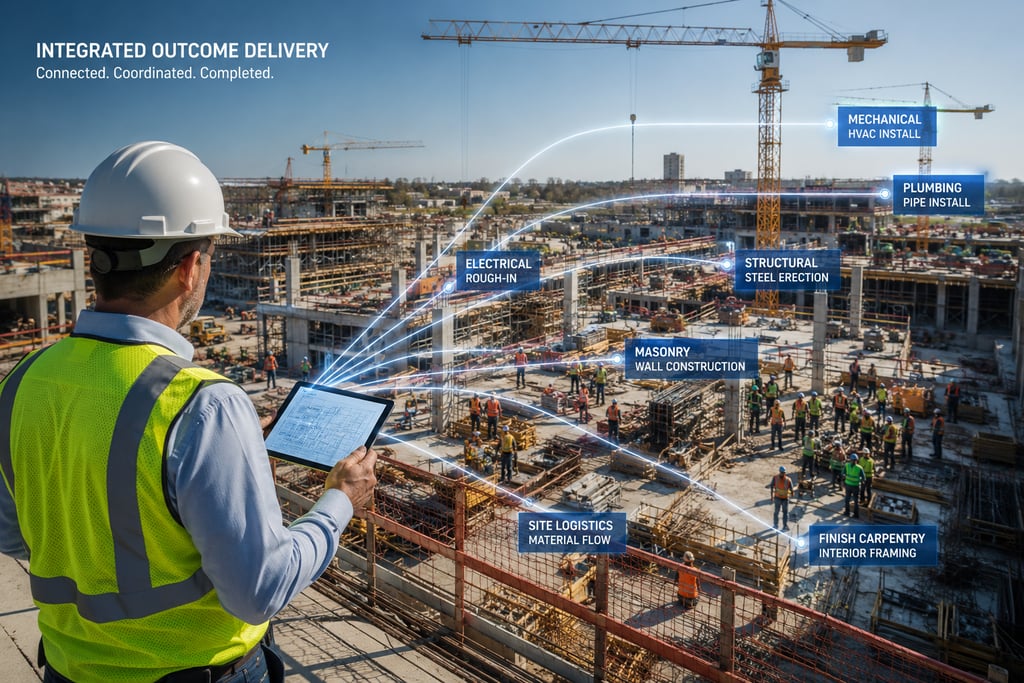
The Construction Analogy: Consider the process of building or remodeling a commercial property. A property developer does not spend their days independently sourcing, interviewing, and scheduling individual bricklayers, electricians, and plumbers. Attempting to do so invariably results in structural misalignment, missed deadlines, and compounding expenses. Instead, developers engage a principal firm that deploys a dedicated site manager or foreman. The foreman understands the holistic blueprint, speaks the specialized language of each trade, enforces structural compliance, and ensures that every individual contribution fits perfectly into the broader framework. The developer pays for an integrated outcome, not a collection of uncoordinated hours.
The Three-Tiered Blueprint: How Structured Oversight Guarantees Premium Delivery
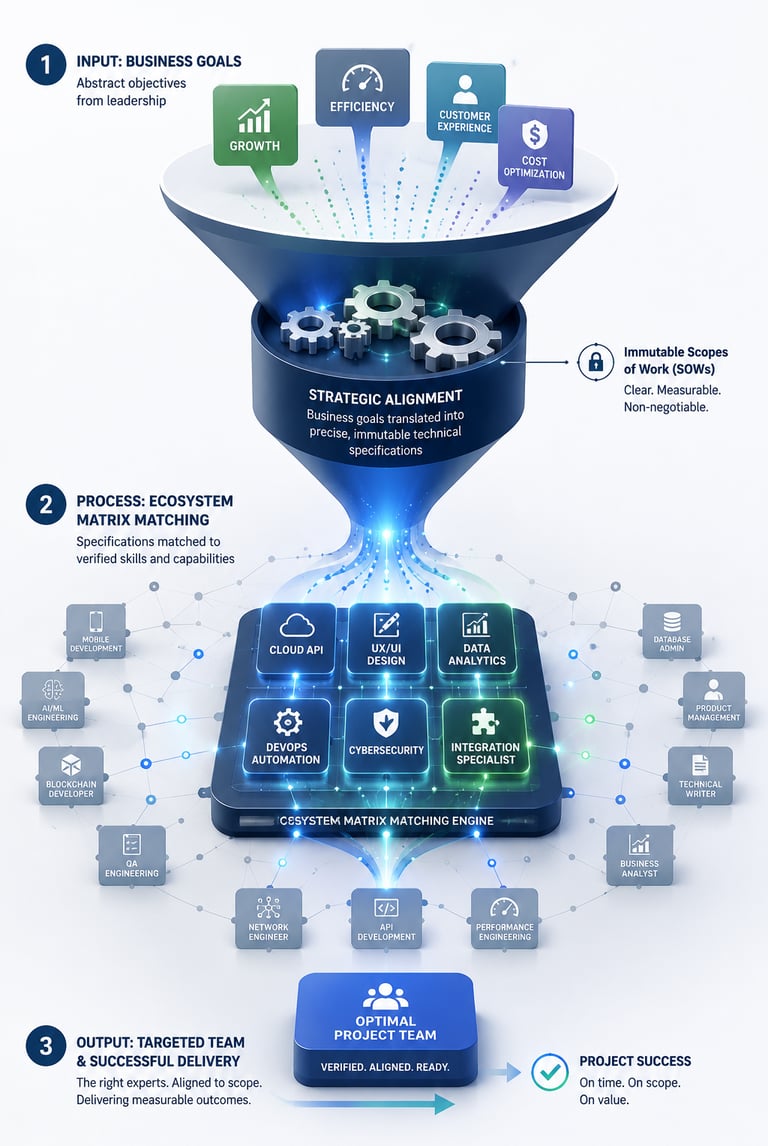
To deliver consistently flawless outputs without placing an operational burden on the client, an enterprise-grade service ecosystem relies on a robust, three-tiered operational framework. This strategic structure moves away from individual-dependent variables and replaces them with systemic reliability.
1. Strategic Alignment and Requirement Translation
The primary point of failure in most complex projects occurs before a single line of work is executed. It stems from a gap in translation between high-level business objectives and granular technical execution. When businesses interface directly with tactical workers, scope creep and misaligned expectations run rampant.
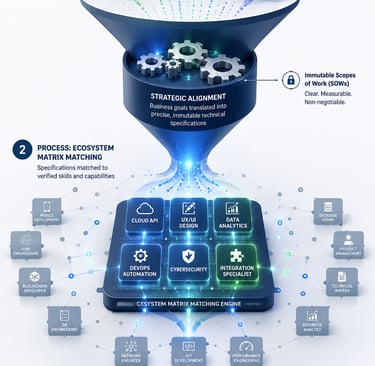
A professional service architecture solves this by acting as the primary translator. We ingest your high-level business goals, core constraints, and qualitative vision, and systematically map them into an immutable, technically precise Scope of Work (SOW). By formalizing precise delivery benchmarks and objective criteria from the outset, we eliminate ambiguity. This guarantees that when execution begins, it is aligned with your overarching commercial strategy rather than a siloed tactical perspective.
2. Ecosystem Matrix Matching and Resource Allocation
The global talent market is highly fragmented. A specialist who excels in one specific methodology or framework may be entirely unsuited for another, despite sharing the same general title. For an organization to independently vet, interview, test, and manage individuals across multiple disciplines is an incredibly resource-intensive endeavor.
Under a managed Drop Service model, this operational complexity is fully internalized by the provider. Clients do not look at resumes or manage individual capacity. Instead, your optimized project blueprint is introduced into a deeply vetted, highly specialized network. The matrix matches specialized components of the project to exact operational nodes that possess verified track records in that specific micro-domain. By decentralizing the execution across an established ecosystem while centralizing management, the operation achieves elite competency without a single point of failure.
3. Centralized Quality Assurance and Institutional Vetting
The defining characteristic of an enterprise-grade service is accountability. In a fragmented individual-contractor model, the client is forced to act as the quality control mechanism. If a deliverable is substandard, flawed, or missing critical business context, the client must invest their own time reviewing, providing feedback, and managing iterations.
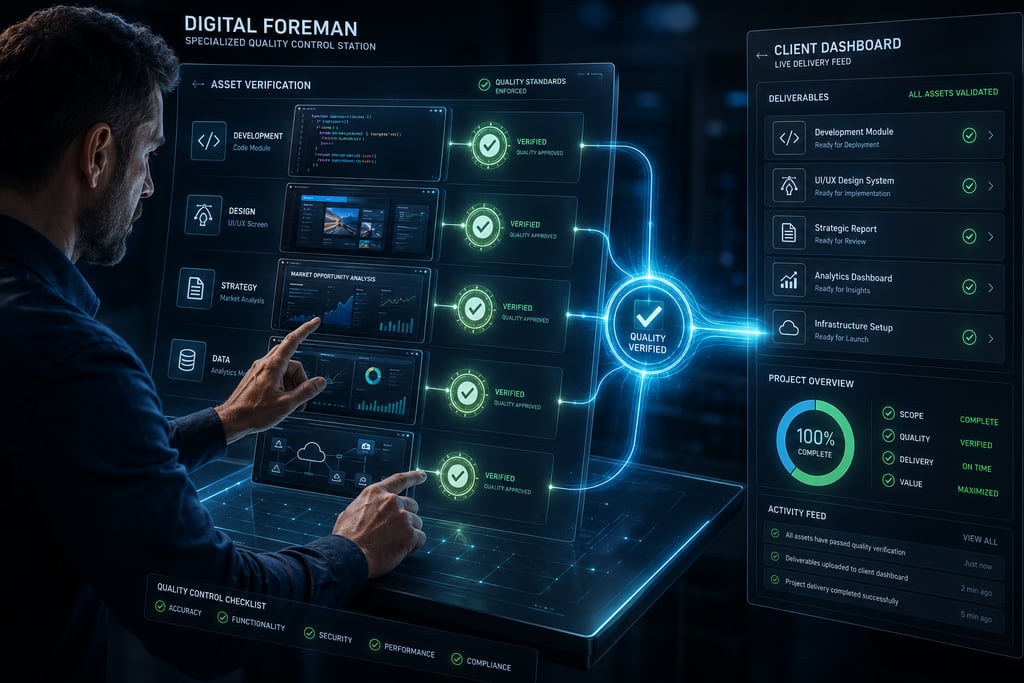
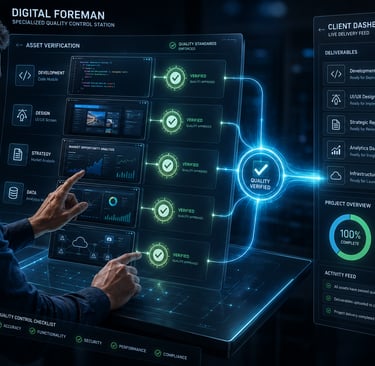
A structured managed service completely redefines this relationship through an independent Quality Assurance (QA) layer. Before any milestone, asset, or strategic asset is delivered to your dashboard, it must pass a rigorous institutional review led by our internal quality managers—the digital foremen. The output is audited against the original SOW, brand parameters, and industry-best performance metrics. What arrives in your hands is not a draft requiring your cognitive energy to fix; it is a polished, fully validated asset ready for immediate deployment.
In the realm of professional services, this is precisely where a structured ecosystem provider shifts the paradigm. The value proposition does not reside in merely acting as an intermediary to source talent; it resides in serving as the architectural layer—the digital foreman—that insulates your business from execution friction and operational risk.
Conclusion: Purchasing Outcomes, Not Overhead
Ultimately, the choice facing modern operators is not whether to leverage scalable external teams, but how to manage them. Relying on fragmented execution turns your executive team into micromanagers, shifting focus away from growth and market penetration.
By partnering with a structured operations hub like ModusStack, you stop purchasing unmanaged labor hours and start acquiring predictable, high-tier business outcomes. You gain access to a scalable, enterprise-grade engine backed by systematic precision, continuous oversight, and guaranteed quality control—all accessible through a single, seamless channel.
Ready to optimize your operational footprint?
ModusStack
Delivering high-performance digital and AI
services
© 2026 ModusStack. All rights reserved. Operated by VBK THAI COMPANY LIMITED
solutions through methodical efficiency.
Company
Legal
Terms and conditions